
What Is Grounding/Earthing? Part 1: Physics and Chemistry 101


Depending on how crunchy your social media algorithm is, you might have heard about grounding before. Or Earthing.
The short story is that we are electrical beings. And like all animals, we evolved with constant contact to the Earth. This meant we were always in electrical balance.
But our modern world full of plastic has created a barrier between that electrical neutrality. So we now build up an electrostatic charge that leads to lots of problems.
By reconnecting with Mother Earth we find a neutral balance. Our health restores as chronic inflammation and disease melt away.
It’s a classic “Modern society bad. Mother Nature good” tale. And I love those.
I’ve been a fan of grounding/Earthing for a long time. But mostly because I bought into the poetic story about how it worked.
But does it actually work?
I felt good when I stood outside. And studies showed that something was happening. But I didn’t really know what was going on. Or if my grounding sleep mat did anything.
Plus, I do my best not to tell people something that I don’t know to be true. So I went down the rabbit hole to figure out what was going on.
And what I found surprised me.
I did my best to summarize it in this 3 part series. It’s nerdy and long. But you can do it.
Bottom line: Go outside. Stand on wet ground. Get in the sunlight. Earthing works. But it’s not the full story. There’s a lot more going on.
If you want to know why, keep reading.
-
Grounding and Earthing describe the exchange of electrons to neutralize a charge.
Grounding refers to the connection of an electrical system to a larger, neutral sink. Buildings are grounded, for example. It’s what the third prong on outlets are for.
Earthing refers to the electrical conduction that happens when biological systems touch the earth. Like humans walking on the beach or dogs rolling in the grass.
But before that sounds too confusing, let’s step back.
What are electrons?
Well, everything we know of in the universe is made of elements. These are the building blocks of you, me, and all material objects.
These elements are made of smaller things called subatomic particles. And there are three types: electrons, protons, and neutrons. Each has a different electric charge.
These three particles interact with each other based on their electrical charges.
What are electrical charges?
It’s actually a good question. Where does the essential nature of a charge come from?
Why are some things positive and others negative? Well, I don’t know. And I couldn’t find a clear answer. But that seems to be the basic essence that makes life possible.
Ancient eastern philosophy would call this tension yin and yang. Order and chaos. Masculine and feminine. We all know that it exists but it’s hard to specify.
We couldn’t reproduce if we didn’t have males and females. And the polarity of masculine and feminine energies is what makes people crazy in love (or lust).
Some things are positively charged. Other things are negatively charged.
That doesn’t mean positive is good and negative is bad either. It’s just a way to describe the nature of that thing.
Attraction happens between opposite charges.
Repulsion happens between similar charges.
Positive things attract negative things and repel other positive things.
Negative things attract positive things and repel other negative things.
Now, these subatomic particles are charged.
Electrons have a negative charge.
Protons have a positive charge.
Neutrons have a neutral charge.
You might be thinking… Where did the neutral thing come from? The short answer is that I guess some things are just in the middle.
But I suspect that we’ll find a better way to measure things in the future that will specify what “neutral" means.
These subatomic particles join together to form atoms. Atoms are just groups of sub-atomic particles. They are the smallest organized units that make up elements.
But don’t let the big words scare you. You know what atoms are because you know what elements are. Oxygen, Hydrogen, Iron, Helium, Gold, Magnesium…
In total, there are 118 known elements. And these are arranged by their mass on something called the Periodic Table of Elements:
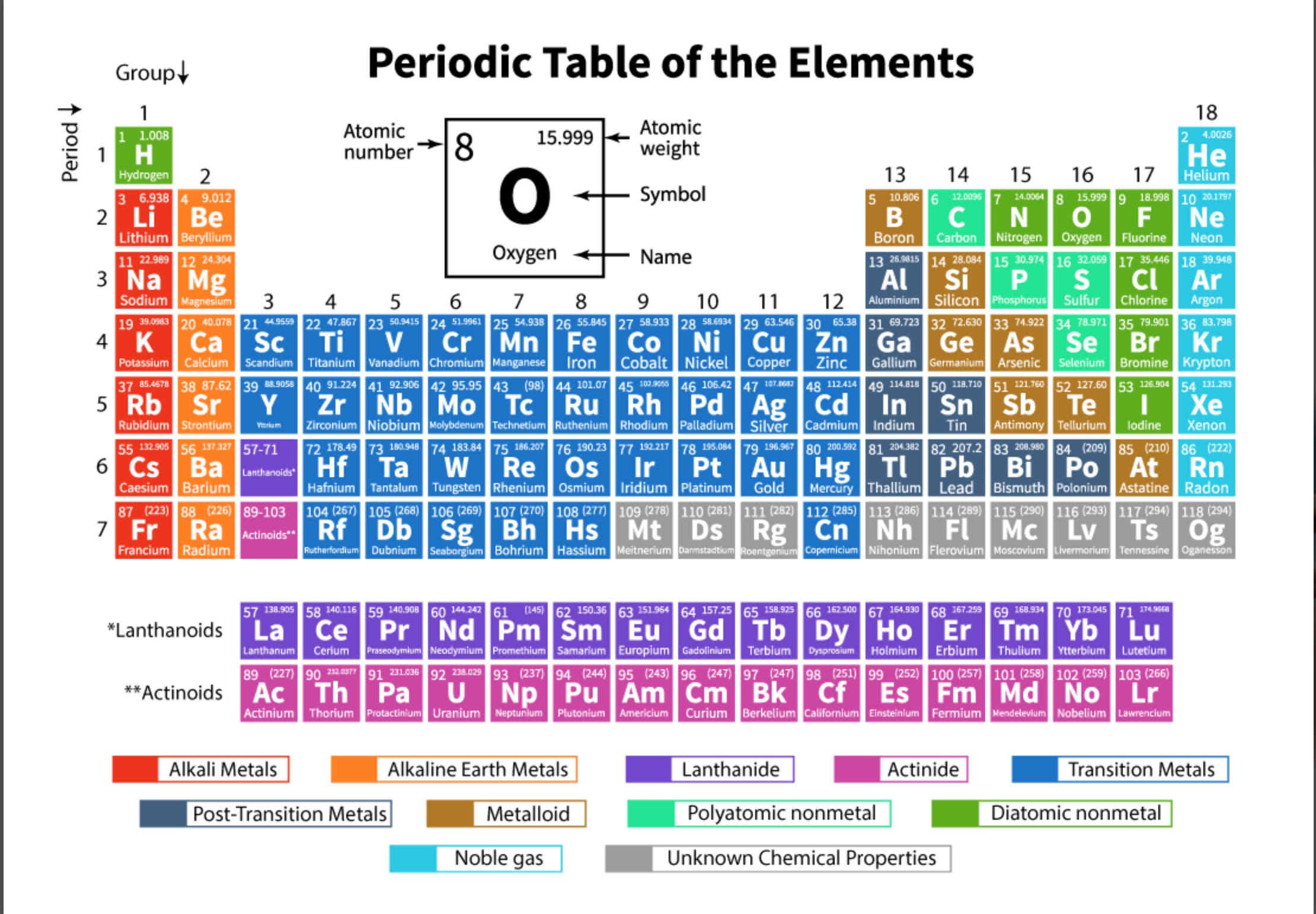
What makes each element different? And how do we know there are 118?
Well, there are basic patterns that elements follow which make things easier for us to organize them.
Specifically, each element has a certain number of protons, neutrons, and electrons.
Let’s return back to the subatomic particle stuff for a moment.
Every atom is made of two parts: A positively charged nucleus and a negatively charged electron field.
The nucleus is made up of tightly bound protons and nucleons. The positively charged protons give the nucleus its overall positive charge.
Protons and electrons are equally charged. Meaning, the positive charge of a proton is equal to and opposite of the negative charge of an electron.
That means one proton attracts exactly one electron. When a proton has its electron buddy, it’s happy. There is nothing leftover to attract something else.
For example, if a molecule has 6 protons in its nucleus, it will attract 6 electrons.
And protons always pair to an equal amount of neutrons. So in our example above, the atom with 6 protons will also have 6 neutrons in the nucleus. Carbon!
The combined weight of the total number of electrons, protons, and neutrons gives the atom/element its atomic weight.
Electrons have essentially no weight. Protons and neutrons each weigh almost exactly 1 atomic mass unit. In other words, protons and neutrons weigh the same.
The simple factor that distinguishes each element is how many protons it has in the nucleus. The element with 8 protons is different than the element with 9.
There are 118 different elements. Each with a different number of protons. Hydrogen has 1. Helium has 2. Lithium has 3. Beryllium has 4. And so on up to 118.
And every element has the same number of neutrons as protons. Lithium has 3 protons and 3 neutrons. Carbon has 6 protons and 6 neutrons.
Hydrogen is the only element without a neutron. It’s just a proton and electron. And this makes it a very popular element. But we’ll come back to that later.
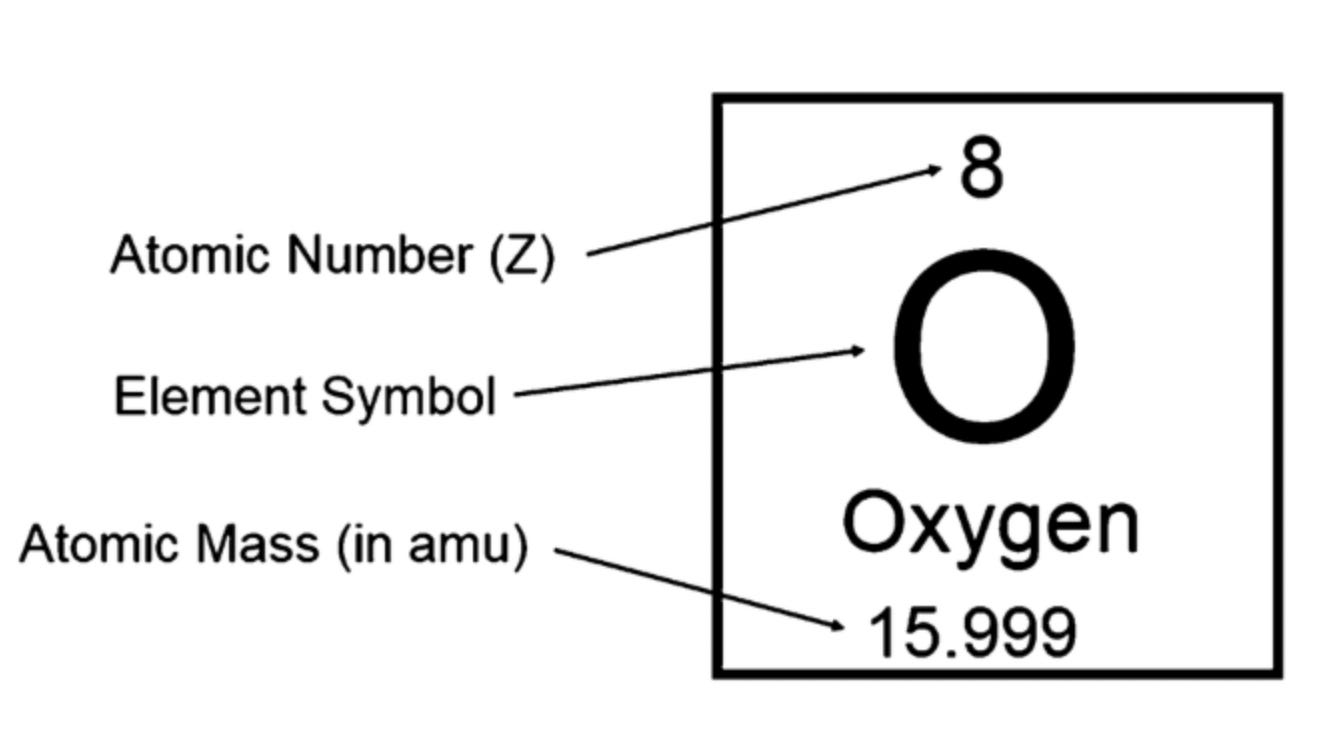
The atomic number of an element is the number of protons it has. Oxygen has 8 protons so its atomic number is 8.
The atomic mass of an element is basically the number of protons and neutrons added together. Oxygen has 8 protons and 8 neutrons and an atomic mass of 15.999.
Now, the next important thing to know is that electrons are not bound tightly to the nucleus. Even though that would make sense, it’s not how it is.
The complex answer is that electrons are basically pure energy and float around in a space called a wavelength. They can and do pass into the nucleus.
And they can and do collapse into protons. This is what happens in radioactive elements. But that’s not the norm. For a more detailed explanation read this.
Even though it’s not technically accurate to think of electrons as tiny balls orbiting the nucleus like the moon around Earth, it’s helpful.
Remember that each atom has two things: A positive, tightly bound nucleus and a negative electron “cloud” around it.
Even though all elections are equal, they are arranged differently in an element.
It seems that the attraction between the quarks in the neutrons and protons is strong enough to keep it together. Otherwise, the positive protons would repel each other.
(Quarks are even tinier subatomic particles that form protons and neutrons.)
But since there is no such thing for electrons, they can only get so close before they start repelling each other.
The solution to this is to organize electrons in levels called shells.
Each shell can hold a specific number of electrons. The innermost level can hold 2. The next one can hold 8. The one after can hold 18. Then 32. Then 50, 72, and so on.
But to make it even more complicated, each shell is broken into sub levels that have specific orbitals. Chemistry math gets hard with the bigger elements.
The good news is that we don’t really need to care about that. Most living things are made of the simple elements at the top of the periodic table.
The thing to know about electron levels is that the further they get away from the nucleus, the less bound they are. Long distance relationships are tough, you know?
The electrons at the furthest level of any atom are called Valence Electrons.
These valence electrons have the highest energy. That means they’re most likely to be the wheelin’ and dealin’ salesmen of the atom.
This matters because if atoms were all perfectly balanced, there would be no interactions between them. That means there would be no life.
But what makes an atom more likely to interact with another atom?
Well, each atom has an equal number of electrons to protons. And not all combinations of electrons shells are equally stable.
This is where something called the Octet Rule comes in. Or the Rule Of 8.
Note that though this doesn’t apply to all elements, it does for many of the main groups elements. Which are the ones we care about.
The octet rules states that elements want to fill their outermost valence electron level.
For most elements in the top three rows (or periods), this works. And it basically lets you connect elements who want electrons to elements who don’t want them.
And though it’s not clear by looking at the table, you can kind of split the top three rows into left and right.
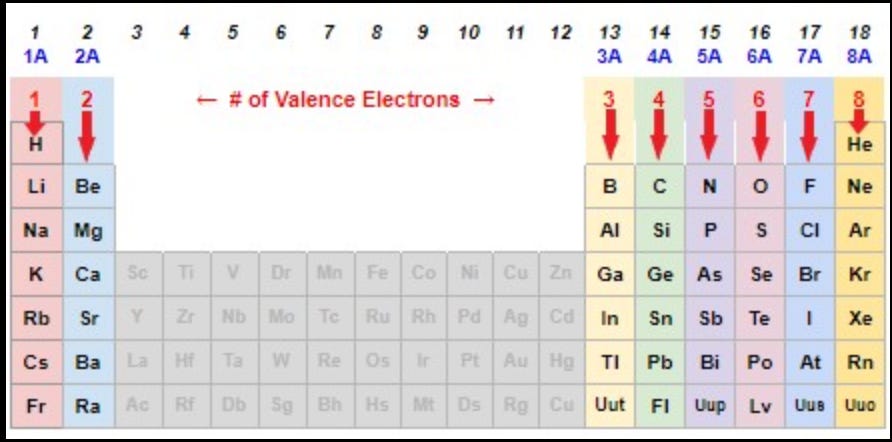
Group 1 has one valence electron. Group 2 has two. Skip a few rows…. Group 13 has 3 valence electrons. Group 14 has 4. Group 15 has 5. Group 16 has 6. 17 has 7. 18 has 8.
See? Totally obvious!
The elements on the left want to give away electrons.
The elements on the right want to take electrons.
This sharing of electrons between atoms is what makes molecules.
The exceptions to this are the elements on the far right side in gold. They’re called the Noble Gasses. And they already have a complete outer valence shell.
That means they’re not very reactive and typically don’t form molecules easily. I guess they think they’re too good for it or something.
But every other element is trying to be like a Noble Gas. They want harmony.
This creates a marketplace of polarity that organizes element interaction.
To make this clear, let’s unpack a simple example… Table salt.
The fancy term for table salt is sodium chloride. Or NaCl.
You can see that sodium (Na) is on the far left. That means it has one electron floating in its valence shell. And it would like to get rid of that.
That’s why the chemical symbol for sodium is usually Na+. It wants to lose an electron. But remember, losing something negative is a positive thing.
Chlorine is on the right and sitting in group 17. That means it has 7 valence electrons. It would love to get one more.
That’s why the chemical symbol for chlorine is usually Cl-. It wants to gain an electron. And remember, gaining something negative is a negative thing.
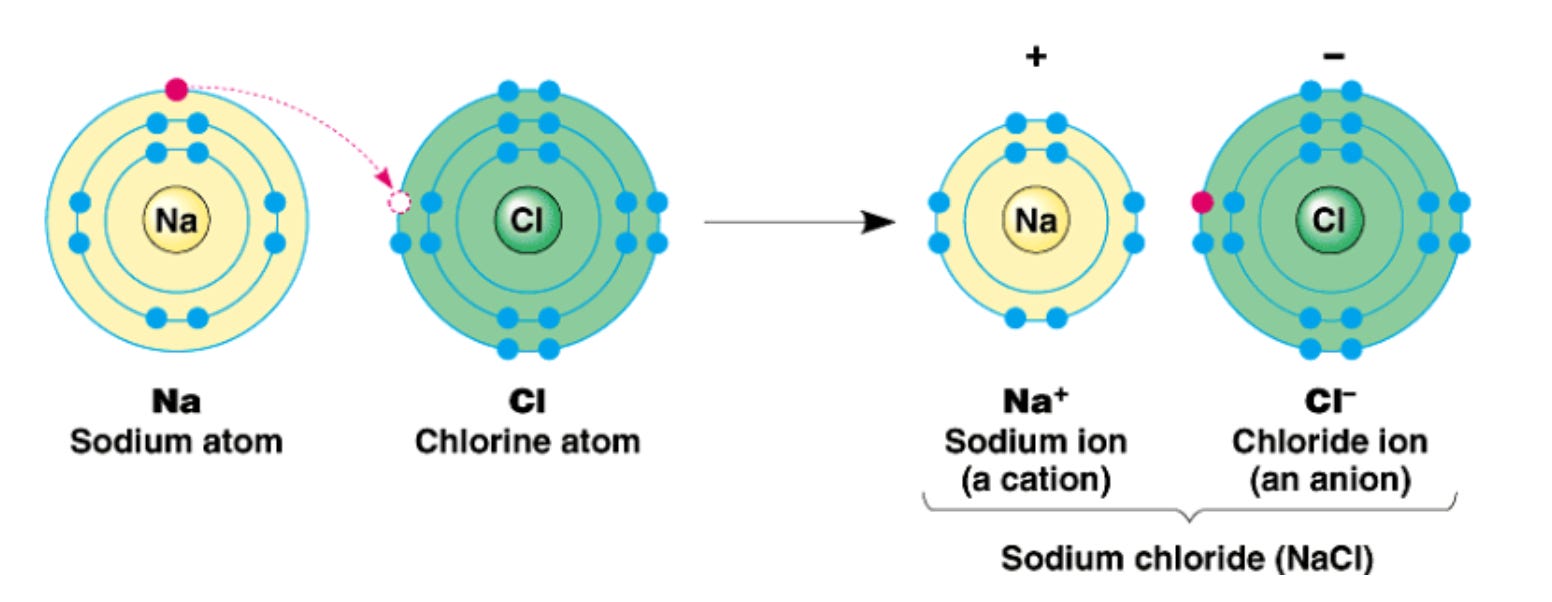
These two create an ionic bond when sodium lends its extra electron to chlorine. It’s a match made in heaven! (Or maybe just in my mouth…)
Also, ionic bonds are different than covalent bonds. Ionic bonds create ions, which are charged particles. This charge lets electricity travel for grounding. But that’s for part 2.
To be clear, sodium isn’t “losing” an electron. It’s just sharing it with chlorine to create the new molecule sodium chloride. If they broke up, sodium would keep its electron.
And another clarification. When chloriNe is combined with something that turns it into a salt (or other molecule), it’s referred to as chloriDe. Silly, I know.’
-
But we’ll pause here before moving on to some of the chemistry and electricity stuff in part 2. It’s dense, I know. But you’ll appreciate having the full story soon enough!